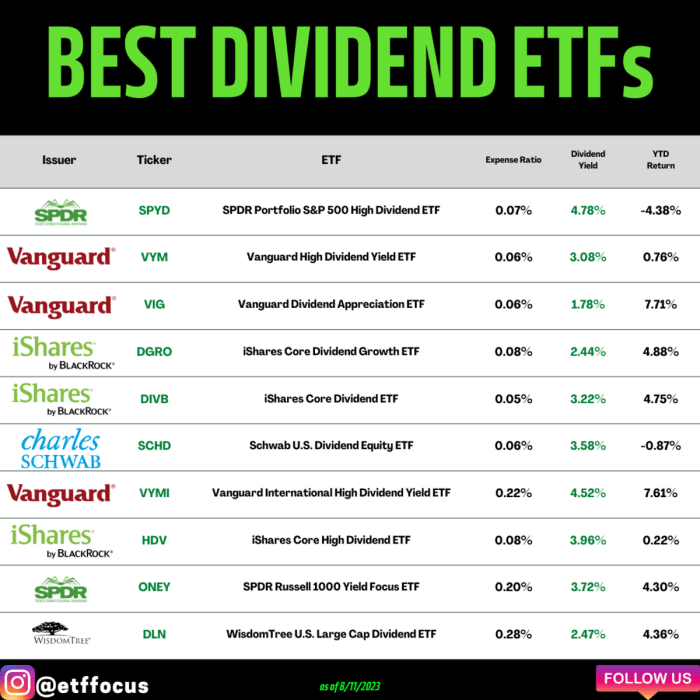
Starting with Best Dividend ETFs, this guide delves into the world of dividend investing, offering valuable insights and recommendations for investors seeking stable returns and growth opportunities.
Exploring the nuances of Dividend ETFs versus individual stocks, this overview provides a roadmap for constructing a diversified portfolio tailored to your financial goals.
Introduction to Dividend ETFs
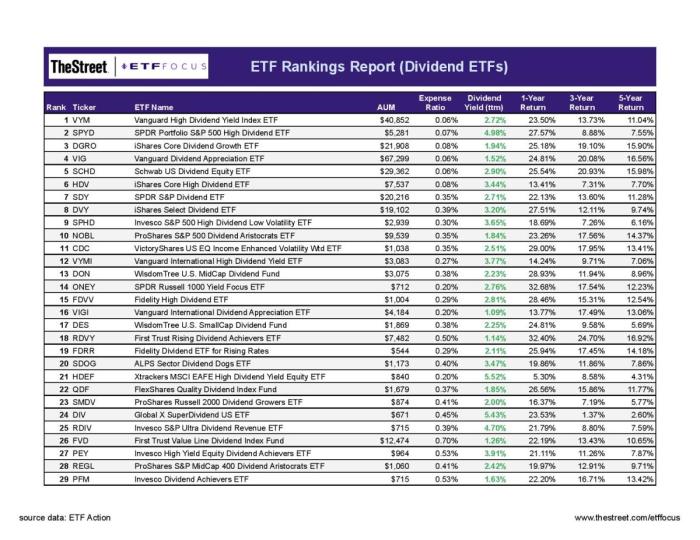
Dividend ETFs, or exchange-traded funds, are investment funds that focus on stocks that pay out dividends to their shareholders. These ETFs are designed to provide investors with a steady income stream through the dividends received from the underlying stocks.
Differences from Regular ETFs
Unlike regular ETFs that may track a specific index or sector, Dividend ETFs specifically target companies with a history of consistent dividend payments. This focus on dividends can provide investors with a more stable source of income compared to other types of ETFs.
Benefits of Investing in Dividend ETFs
- Diversification: Dividend ETFs typically hold a diversified portfolio of dividend-paying stocks, reducing the risk associated with investing in individual stocks.
- Income Generation: Investing in Dividend ETFs can provide investors with a reliable source of income through regular dividend payments.
- Long-Term Growth: Companies that consistently pay dividends tend to be financially stable and are often well-positioned for long-term growth.
Importance of Dividends in an Investment Portfolio
Dividends play a crucial role in a well-rounded investment portfolio as they can provide a steady stream of income, especially during market downturns. Additionally, reinvesting dividends can help accelerate the growth of the portfolio over time.
Factors to Consider When Choosing Dividend ETFs
When selecting the best Dividend ETFs, investors should carefully evaluate various factors to make informed decisions. Key considerations include dividend yield, expense ratio, historical performance, and diversification within the ETF for effective risk management.
Dividend Yield
Dividend yield is a crucial factor to consider when choosing Dividend ETFs. It represents the annual dividend income as a percentage of the ETF’s price. Investors typically look for ETFs with a higher dividend yield to maximize their income potential.
Expense Ratio
The expense ratio of a Dividend ETF is another important factor to evaluate. This ratio reflects the annual fees charged by the fund manager for managing the ETF. Lower expense ratios are preferred by investors as they can impact the overall returns on investment.
Historical Performance
Analyzing the historical performance of a Dividend ETF is essential for understanding how it has performed in different market conditions. Investors should review the ETF’s past performance to gauge its consistency and potential for delivering returns over the long term.
Diversification
Diversification within a Dividend ETF is crucial for effective risk management. By investing in a diversified portfolio of dividend-paying stocks, investors can reduce their exposure to individual stock risk. A well-diversified ETF can help spread risk across different sectors and companies.
Top Dividend ETFs in the Market
When it comes to investing in Dividend ETFs, there are several options available to investors. These ETFs provide a way to gain exposure to a diversified portfolio of dividend-paying stocks while also offering the potential for income generation and long-term growth.
Vanguard Dividend Appreciation ETF (VIG)
The Vanguard Dividend Appreciation ETF (VIG) is one of the most popular Dividend ETFs in the market. This ETF focuses on companies that have a history of increasing their dividends year over year. VIG has a low expense ratio and provides exposure to stable and reliable dividend-paying companies.
iShares Select Dividend ETF (DVY)
The iShares Select Dividend ETF (DVY) is another top Dividend ETF that focuses on high dividend-yielding stocks. DVY tracks the performance of the Dow Jones U.S. Select Dividend Index and provides investors with exposure to companies that have a consistent track record of paying dividends.
Schwab U.S. Dividend Equity ETF (SCHD)
The Schwab U.S. Dividend Equity ETF (SCHD) is known for its focus on high-quality dividend-paying stocks. SCHD tracks the Dow Jones U.S. Dividend 100 Index and invests in companies with strong fundamentals and attractive dividend yields. This ETF is popular among investors looking for both income and growth potential.
Performance Comparison
When comparing the performance of these top Dividend ETFs, it is essential to consider factors such as dividend yield, expense ratio, holdings, and historical returns. Each ETF has its unique approach to selecting dividend-paying companies, which can impact its performance in various market conditions.Overall, investing in Dividend ETFs can be a great way to build a diversified portfolio with a focus on income generation and long-term growth.
It is essential for investors to conduct thorough research and consider their investment goals before choosing the right Dividend ETF for their portfolio.
Dividend Stocks vs. Dividend ETFs
When it comes to investing in dividend-paying companies, investors often face the decision of whether to buy individual dividend stocks or invest in Dividend ETFs. Both options have their own set of advantages and disadvantages, so it’s important to understand the differences between the two before making a decision.
Individual Dividend Stocks
Investing in individual dividend stocks involves purchasing shares of a specific company that pays dividends to its shareholders. This approach allows investors to directly own shares in a particular company and benefit from its dividend payouts. However, this strategy can be risky as it exposes investors to the performance of a single company, which can be volatile.
- Pros:
Direct ownership of specific companies
Potential for higher returns if the company performs well
- Cons:
Higher risk due to lack of diversification
Requires more time and research to select individual stocks
Dividend ETFs
On the other hand, Dividend ETFs offer a more diversified approach to investing in dividend-paying companies. These funds pool together a collection of dividend-paying stocks into a single investment vehicle, providing investors with exposure to multiple companies within a specific sector or index. This can help reduce risk and volatility compared to investing in individual stocks.
- Pros:
Diversification across multiple companies
Lower risk compared to individual stocks
- Cons:
Lower individual stock control
Management fees associated with ETFs
In conclusion, Best Dividend ETFs are a strategic investment choice for those looking to enhance their portfolio with reliable income streams and potential capital appreciation. With the right selection of funds, investors can achieve a balanced and resilient financial future.
Expert Answers
What are Dividend ETFs?
Dividend ETFs are exchange-traded funds that specifically focus on holding a diversified basket of dividend-paying stocks, providing investors with a convenient way to access regular income and potential growth.
How do Dividend ETFs differ from regular ETFs?
Unlike regular ETFs, Dividend ETFs concentrate on companies that distribute a portion of their earnings to shareholders in the form of dividends, making them ideal for income-seeking investors.
What factors should I consider when choosing Dividend ETFs?
Key factors to consider include dividend yield, expense ratio, historical performance, and the fund’s holdings to ensure alignment with your investment objectives and risk tolerance.


